

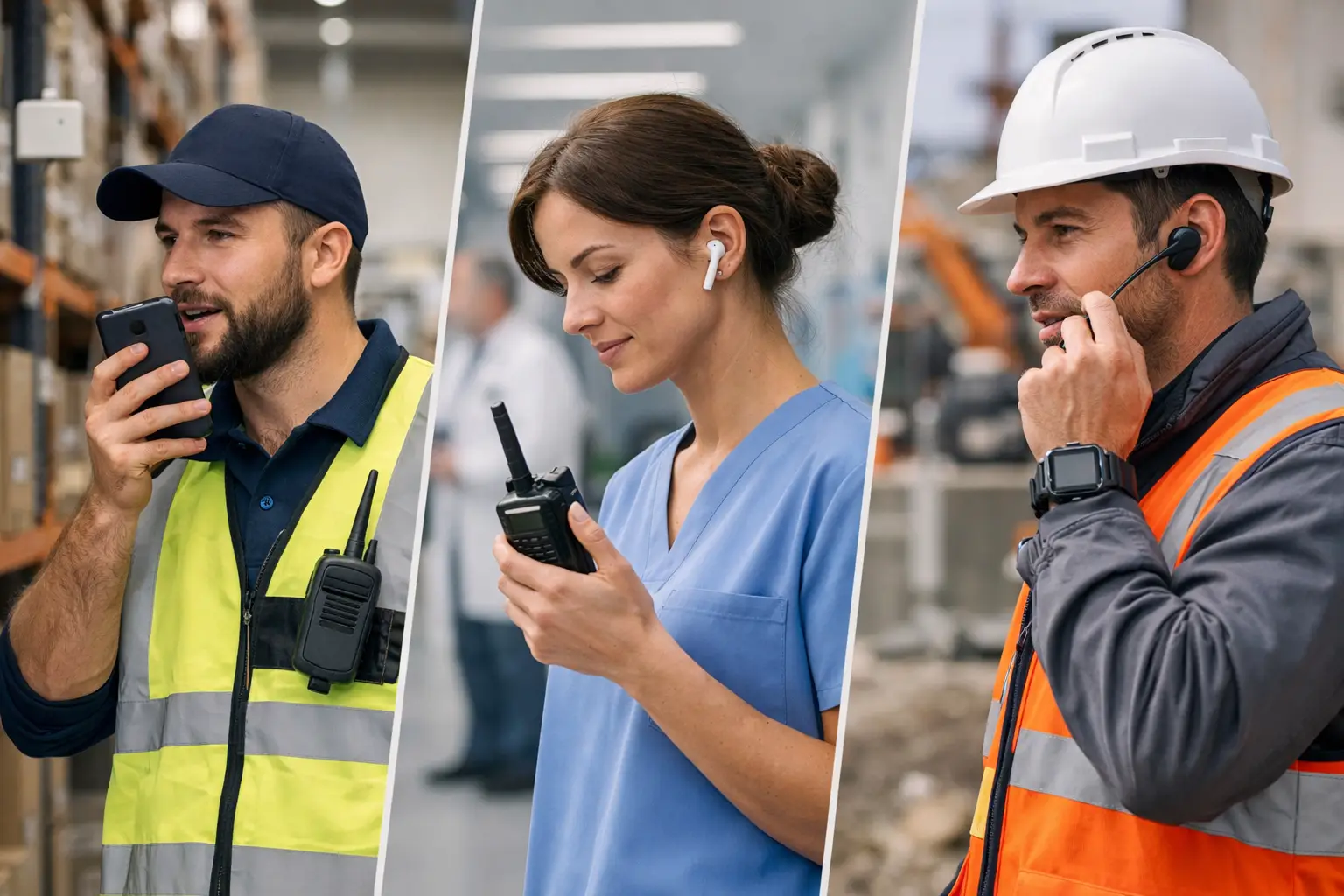
A missed radio call in a large hospital, a cleaner unable to confirm a completed task, or a lone engineer working without a quick way to request help are not simply communication problems. They are operational blind spots. The right communication tools for deskless workers give teams a practical way to connect people, places and events – particularly where staff do not sit at a desk, carry a laptop or remain in one location.
For organisations operating across sites, shifts and complex buildings, the question is not whether teams can send messages. It is whether the business can identify who is available, where help is needed, what work has been completed and how quickly it can respond when something changes.
Why deskless communication is different
Deskless work takes place on wards, production lines, construction sites, retail floors, estates, kitchens and customer premises. Workers may be moving constantly, wearing protective equipment, operating machinery or working in areas with poor mobile coverage. A communication tool designed around email, desktop notifications and self-reported updates often creates more friction than it removes.
Radio systems remain useful for immediate voice contact, but they do not always provide a record of the request, identify the nearest appropriate responder or confirm that help arrived. Mobile apps can support messaging and task updates, yet their value depends on workers carrying, charging and using a personal or company device consistently. In safety-critical settings, that dependency deserves careful scrutiny.
A stronger approach combines communication with reliable operational context. Real-time location systems, commonly called RTLS, establish where people and assets are within a defined environment. That location data can then support alerts, task allocation, attendance records and proof that an activity occurred at the required place and time.
What effective communication tools need to do
The most suitable solution depends on the environment, workforce and level of location precision required. A construction project with dispersed outdoor teams has different needs from a manufacturing plant with high-value equipment and tightly controlled work zones. However, effective tools usually address four connected operational requirements.
Reach the right person quickly
Sending a notification to everyone may be easy, but it can slow response and create alert fatigue. Location-aware communication can direct a request to the nearest available or qualified worker, rather than relying on manual calls to find someone.
For example, a facilities manager can issue a task when an environmental sensor identifies a problem in a specific area. The system can use current location information to identify an appropriate nearby operative, while retaining a record of allocation and response. The benefit is not messaging for its own sake. It is reducing the time spent finding the right person.
Give workers a simple way to raise an alert
In urgent circumstances, a worker should not need to unlock a phone, open an application and type an explanation. Wearable badges and dedicated buttons can provide a more direct route to an SOS alert or lone-worker check-in. When combined with location data, responders receive both the alert and meaningful information about where assistance may be required.
This is particularly relevant for lone workers, security staff, estates teams and healthcare employees. It does not remove the need for appropriate risk assessment, procedures or training. It does, however, give those procedures a more dependable operational trigger.
Verify activity without adding paperwork
Deskless teams are frequently asked to prove attendance, patrols, inspections, cleaning or maintenance work. Paper forms and retrospective updates are difficult to audit and can distract staff from the work itself.
Location and time data can provide a clearer record when it is connected to the task being performed. A worker entering a defined verification zone, for example, can support evidence that they reached the correct location. The same principle can assist with clocking in and out, access events or proof of completion. It is not a substitute for quality checks where the quality of work matters, but it can establish a stronger factual trail than a manually completed form alone.
Work across the full site, not only outdoors
GPS is well suited to outdoor positioning, such as field services, social housing or large construction estates. It is less reliable within buildings, where signals can be obstructed or reflected. Indoor operations therefore need different technology.
BLE, or Bluetooth Low Energy, can support proximity and zone-based awareness through beacons, badges and gateways. It is often appropriate where the key question is whether a person or asset is near, in or out of a defined area. Ultra-wideband, or UWB, is designed for more precise indoor positioning. In supported deployments, Sense UWB positioning can provide accuracy of up to 10 cm, which can be valuable where nearby is not specific enough.
Choosing between mobile apps, radios and location-aware wearables
There is no single replacement for every communication channel. Radios can remain the best option for immediate group voice communication. Mobile applications can work well for detailed information, photographs, schedules and non-urgent updates. The issue is whether those tools can reliably connect activity to the real-world conditions in which work takes place.
Location-aware wearables add a different capability. A badge, tag or button can be carried without requiring staff to use a screen at every stage. Connected gateways receive signals from these devices and pass relevant data to software. Beacons can define locations or zones, while environmental sensors can identify conditions that need attention.
Together, these components create physical-world data: not just that a task was marked complete, but that a worker was present at a defined location when the event was recorded. This matters where response times, safety, compliance and service delivery are assessed after the fact.
Sense Presence combines proprietary hardware, firmware and software to support this type of operation across indoor and outdoor environments. Sense Badges, tags, gateways, buttons, beacons and sensors can connect worker presence, asset visibility and operational events. With SenseAutomate, organisations can configure location-aware workflows without building every process from scratch.
Deployment questions that should shape the decision
Before selecting a platform, establish the operational decision that location data needs to improve. “We want to track staff” is too broad and risks creating resistance. “We need to locate the nearest trained responder after an SOS alert” or “we need auditable evidence of planned inspections” identifies a specific requirement that can be designed and tested.
Accuracy should be matched to the use case. Zone-level BLE awareness may be sufficient for confirming that a trolley remains on a floor or that a worker entered a service area. High-precision UWB may be justified for complex indoor environments where asset searches, workflow analysis or safety response require a more exact position. Higher precision can involve more infrastructure planning, so the operational value needs to warrant it.
Coverage also requires practical assessment. Consider building materials, outdoor areas, basements, lift shafts, restricted zones, worker movement patterns and device-wearing requirements. Gateways and other infrastructure must be placed to support the required coverage and resilience, rather than simply installed where it is convenient.
Finally, address privacy and governance early. UK organisations should be clear about the purpose of any worker location system, the data collected, who can access it, how long it is retained and the safeguards in place. Engagement with staff and representatives is not merely a communications exercise. It helps ensure the deployment is proportionate, understood and aligned with legitimate safety and operational needs.
Turning communication into action
The value of a deskless communication system increases when it can trigger the next operational step. An SOS can notify the appropriate team with the worker’s location. A fall-detection event can initiate an escalation workflow. A sensor reading can create a task for the nearest operative. Arrival in a verification zone can record completion and notify a supervisor where an exception occurs.
These workflows should be designed around real operating procedures, including what happens if a worker does not respond, if the assigned person is unavailable or if a location signal is uncertain. Automation is most useful when it makes a known process faster and more consistent, not when it obscures responsibility.
Frequently asked questions
What are communication tools for deskless workers?
They are tools that help mobile, frontline and site-based staff receive information, request assistance, report activity and coordinate work. They can include radios, mobile applications, wearable panic buttons, task systems and location-aware badges or tags.
Is GPS enough to locate deskless workers?
GPS can be effective outdoors, but it is generally not suitable for precise indoor positioning. Indoor requirements may call for BLE for zone awareness or UWB where more accurate position data is needed.
Can location data prove a task was completed?
It can support proof that a worker or device was at a defined place at a recorded time. For many tasks, this creates a useful audit trail. It should be combined with other evidence where the standard or quality of completion must also be assessed.
Are wearables better than mobile apps?
It depends on the task. Mobile apps are useful for detailed updates and information-rich workflows. Wearables can be more practical for SOS alerts, check-ins and location events because they reduce dependence on a worker actively using a phone.
How should organisations approach worker privacy?
Start with a clear, specific purpose and collect only the information required for that purpose. Define access, retention and escalation rules, communicate openly with workers, and ensure the approach reflects relevant UK data protection and employment obligations.
The most useful communication tool is the one that gives staff a clear route to help, gives managers reliable evidence of what is happening, and enables the next decision to be made without delay.