

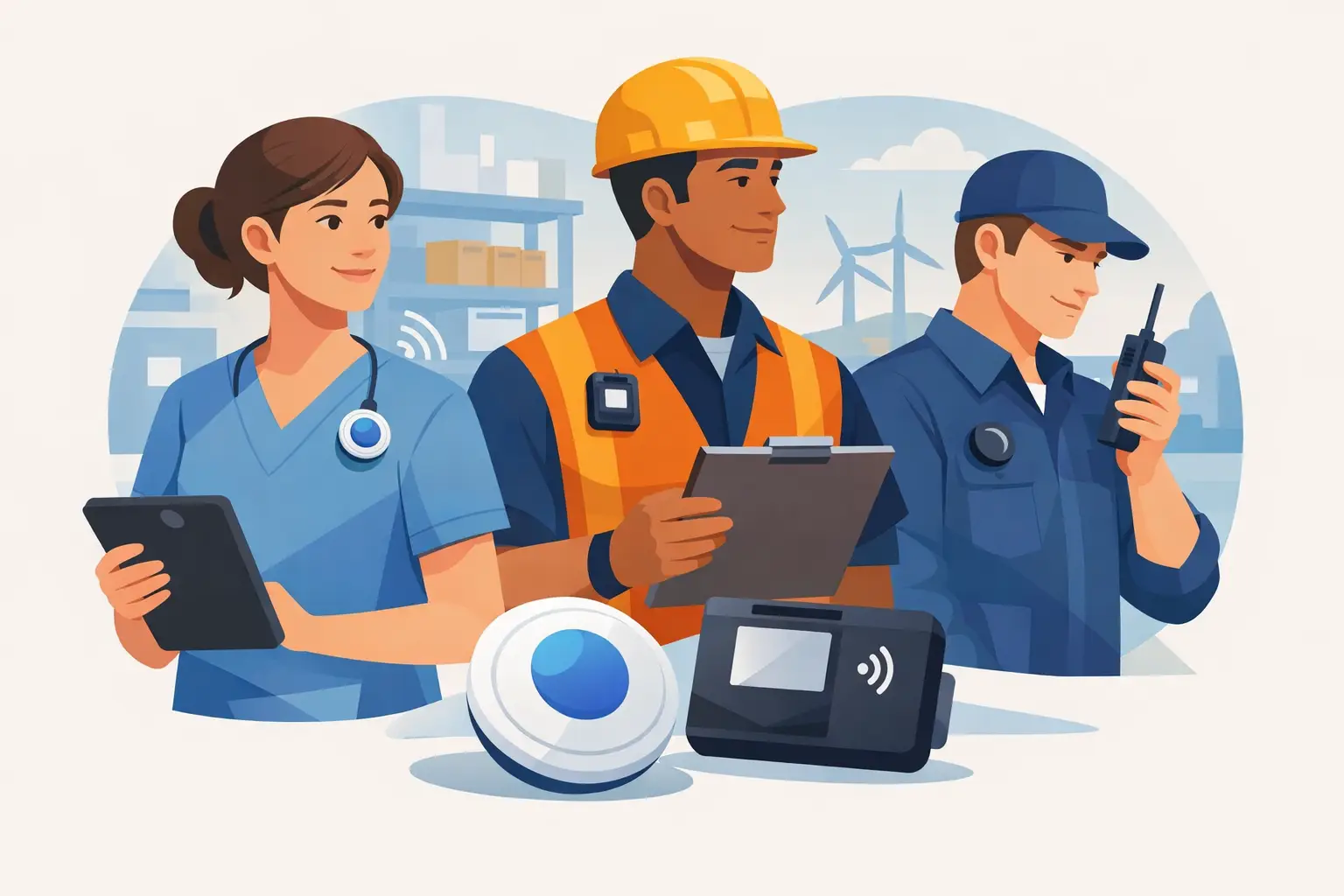
A supervisor should not have to make three radio calls to find a porter needed on a hospital ward, or wait until the end of a shift to discover a lone engineer missed a critical check. Wearable badges for deskless workers give organisations a direct, practical connection to people who spend their day away from a desk, without asking them to carry, charge or navigate a smartphone.
For operations leaders, the value is not simply knowing where somebody is. It is being able to verify attendance, direct the nearest qualified worker to a task, protect staff when an incident occurs and understand how work actually moves through a site. The right badge turns real-time location and worker status into faster, more confident operational decisions.
Why deskless work needs a different interface
Desk-based systems assume employees have regular access to a laptop, email account and corporate apps. That assumption breaks down on a production line, across a retail estate, within a care setting or on a construction project. Workers may wear gloves, move between restricted areas, work outdoors or need both hands free. A phone can be unavailable, unsuitable for a safety-critical environment or simply impractical during a busy shift.
A connected badge is purpose-built for these conditions. Worn on a lanyard, uniform or personal protective equipment, it creates a consistent interface between the worker, their supervisor and the workplace. One device can support identity verification, location awareness, safety alerts and workflow prompts without placing another screen in the worker’s day.
That distinction matters. Adoption is stronger when technology supports the job rather than interrupting it. For supervisors, it also creates a more reliable operating picture than manual check-ins, radio updates and incomplete timesheets.
What wearable badges for deskless workers can do
A badge becomes valuable when it connects to a wider location and workforce platform. Bluetooth Low Energy can provide broad zone-level visibility across larger environments, while Ultra-Wideband can deliver highly precise indoor positioning – in some deployments, down to 10 cm. GPS or other outdoor location methods can extend visibility beyond the building.
The right level of accuracy depends on the decision being made. Zone-level data may be enough to confirm that a cleaner attended the correct floor or that a retail colleague is on the shop floor. In a hospital, manufacturing facility or secure site, precise room-level location may be needed to find the nearest responder, manage access or analyse movement around critical processes.
Badges can also support verified attendance. A worker may tap in at a reader, authenticate through fingerprint scanning where appropriate, or be confirmed through a combination of identity and location data. This gives workforce and HR teams a stronger basis for timekeeping than a shared terminal or an unverified manual record.
Safety functions are equally important. An SOS button allows a worker to request help quickly. Fall detection and lone-worker monitoring can identify situations where an individual may be unable to call for assistance themselves. When an alert is raised, location data helps the response team see who needs help, where they are and which colleagues are best placed to respond.
From location data to operational action
Location data alone is a map. Operational value comes from linking that map to a clear action.
Consider a facilities team responsible for a large, multi-building site. When a reactive maintenance request is logged, the system can identify available engineers nearby rather than routing work through a chain of calls. A supervisor can see whether the task was attended, how long it took to reach the location and whether recurring faults are creating unnecessary travel.
In healthcare, a badge can help charge nurses locate an appropriate colleague during an escalating situation. It can also provide evidence that routine checks occurred in the required area, while protecting staff who work alone in quieter parts of a building. The aim is not to replace professional judgement. It is to reduce the time spent searching, checking and chasing information when seconds matter.
For manufacturing teams, connected badges can reveal bottlenecks between workstations, support attendance verification at shift start and send an alert when a worker enters a restricted zone. In retail and hospitality, they can help managers allocate cover to the busiest area, respond to customer-facing incidents and understand whether staffing patterns match real footfall and service demand.
The same principle applies across mobile and dispersed teams. If the organisation can see where work is being done and whether help is needed, it can improve service without relying on workers to continually report their own position.
Choose accuracy and functions around the risk
Not every site needs centimetre-level positioning, fingerprint authentication and fall detection. Specifying every capability for every role can add unnecessary cost, complexity and employee concern. The better approach is to start with the operational problem and design the badge experience around it.
Match the technology to the environment
Indoor positioning requires infrastructure. BLE is often a sensible option for area-level visibility across broad spaces, whereas UWB is better suited to use cases requiring unrivalled indoor accuracy, such as room-level response, workflow automation or precise asset and personnel coordination. Outdoor teams may need a different coverage model altogether.
Site materials, building layout, high-value areas and the number of concurrent users all influence the design. A warehouse with metal racking presents different conditions from a social housing service covering a wide geographic area. A proper site assessment prevents an accuracy claim on paper becoming a disappointing experience on the ground.
Keep worker interaction simple
A badge should communicate clearly: press here for help, tap here to confirm attendance, and wear it as part of the normal uniform routine. If a worker must remember several passwords, open multiple applications or interpret complicated notifications, usage will decline when work becomes pressured.
Battery life, charging routines, cleaning requirements and breakaway lanyards deserve the same attention as software features. In frontline operations, the device must withstand the reality of the shift, not just perform well in a demonstration.
Build trust before collecting data
Workers are more likely to accept wearable technology when the purpose is clear and the benefit is visible. A vague promise of ‘productivity monitoring’ can understandably create concern. A clear commitment to faster emergency response, fairer attendance records, less radio traffic and better support for lone workers is more meaningful.
Organisations should explain what is collected, when it is collected, who can view it and how long it is retained. Location policies should distinguish between working time and personal time, especially for mobile roles. Data access should be proportionate: a safety team may need live incident location, while a manager may only need operational reports for their own area.
This is not only a privacy matter. It is a deployment matter. Workers who understand how a badge protects them and removes friction are more likely to wear it consistently. Managers who are trained to use data fairly are less likely to treat location as a shortcut for poor supervision.
Measure the operational change, not just the installation
Badge programmes should be measured against the problem they were introduced to solve. For safety, that could mean time from SOS alert to acknowledgement, response time, or the proportion of lone-worker welfare checks completed. For workforce operations, it may mean attendance exceptions resolved, task response time, travel between jobs or supervisor time saved from manual coordination.
Historical movement data can expose patterns that are difficult to see through anecdote alone. Perhaps a team repeatedly crosses a site to collect equipment, perhaps a particular area creates regular delays, or perhaps staffing levels are correct overall but misaligned at peak periods. These findings support better process design, rather than simply closer observation of individuals.
Sense brings wearable hardware, location infrastructure and workforce software into one operating model, helping organisations connect precise visibility to practical action. The most effective deployments begin with a defined service, safety or workforce outcome, then give teams the data and alerts needed to improve it.
A well-designed badge should feel almost unremarkable to the person wearing it. Yet when a worker needs help, a supervisor needs certainty or a customer needs a faster response, that small device can make the workplace more controlled, safer and easier to run.