

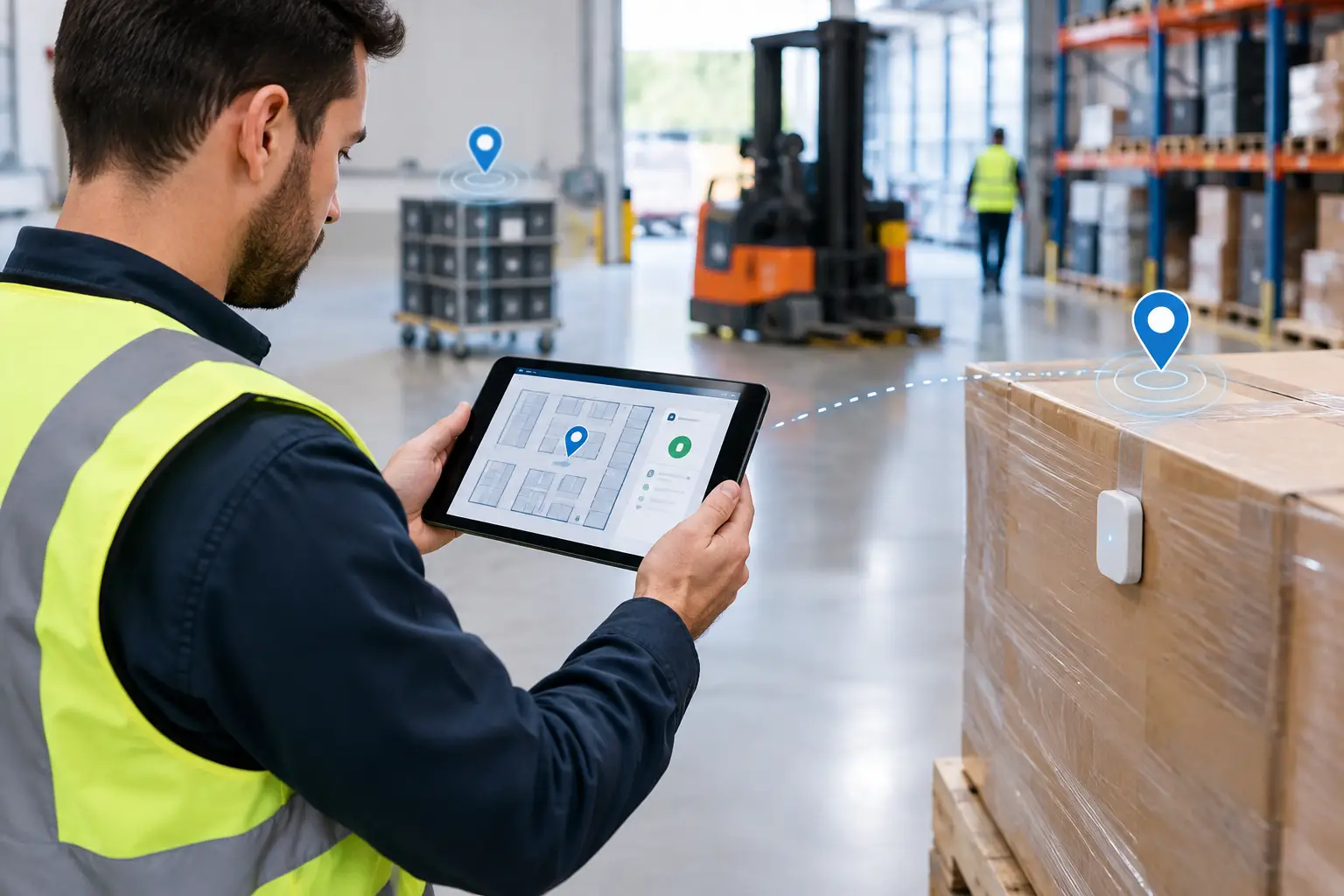
A maintenance team loses 20 minutes locating a thermal camera needed for an urgent inspection. A porter is sent to collect a wheelchair that has already moved wards. A facilities manager cannot confirm whether a floor-cleaning machine reached the required area. These are not simply tracking problems. They are operational delays caused by incomplete physical-world data.
Asset visibility is the ability to know where an asset is, its current status and, where relevant, who is responsible for it, so a team can make the right operational decision. It combines an identifiable asset, location signals and a workflow that turns a position on a map into action. For organisations running complex sites, that can mean finding essential equipment quickly, preventing unauthorised removal, allocating work to the nearest available resource or proving a task happened in the right place.
What does asset visibility mean in practice?
An asset register records what an organisation owns. Asset visibility adds a live or regularly updated operational view. The distinction matters. A register may show that ten radios belong to a site; visibility can show which radio is at reception, which is assigned to a security officer, which has entered a restricted zone and which has not been seen since the previous shift.
The useful level of detail depends on the decision being made. A hospital may need room-level certainty to locate mobile clinical equipment. A construction business may only need to know whether a generator is inside a compound or has left the site. A facilities provider may need zone-level evidence that equipment reached a client area before a service task can be closed.
Location alone is not always enough. A credible system can combine a tagged asset’s position with a timestamp, movement history, device state and relevant contextual signals. This creates a clearer answer to operational questions: Where is it? Has it moved? Is it in the right place? Does someone need to act?
How asset visibility works
Every deployment starts with a physical signal. A tag, beacon or connected device is attached to, placed inside or issued with an asset. Gateways, receivers or mobile networks detect that signal and send location events to software. The platform interprets those events against a site map, defined zones and business rules.
The technology should follow the operating requirement, rather than the other way round.
UWB for precise indoor location
Ultra-wideband, or UWB, is designed for use cases that require high indoor precision. With suitable infrastructure and tags, it can support detailed positioning within an indoor environment. This is relevant when a team must distinguish between neighbouring rooms, bays or work areas, such as locating a high-value tool in a manufacturing plant or identifying which treatment space holds a mobile asset.
That precision comes with deployment considerations. UWB requires planned infrastructure, and the site layout, materials, coverage design and desired certainty all need assessing. It is appropriate when precise location changes a decision, not merely because a map looks more detailed.
BLE for zones and presence
Bluetooth Low Energy, or BLE, can be effective for presence and zone-based visibility. A BLE tag can indicate that an asset is near a beacon or within a defined area, depending on the installation and configuration. This can suit stock rooms, cleaning cupboards, plant areas and workplace zones where the question is whether an item is present rather than exactly where it sits.
BLE can offer a practical balance between coverage, hardware and operational need. However, it should not be presented as precise indoor positioning where the design only supports area-level awareness.
GPS for outdoor and distributed estates
Global Positioning System, or GPS, is well suited to outdoor location where there is a clear view of satellites. It can support visibility of assets moving between customer sites, around large outdoor estates or across field operations. GPS is generally not the answer for accurate indoor location, where signals can be weak or unavailable.
Many organisations need both. A contractor may use GPS to see that a welfare unit is on the right project, then use indoor technology to locate specialist equipment within a workshop or depot. Hybrid environments need a clear handover between technologies, not an assumption that one signal will solve every location problem.
Turn a location signal into an operational workflow
The value of asset visibility appears when a location event triggers a useful process. Without that step, teams may have a better map but continue to rely on radio calls, spreadsheets and search time.
Consider a facilities team managing cleaning equipment across a multi-building estate. Each machine carries a tag. The system knows when a machine enters a designated floor or service zone. That event can support a task workflow: equipment arrival is recorded, the operative completes the required activity, and a supervisor can review proof of completion alongside the time and place. The tag confirms equipment presence, not the quality of cleaning, so the workflow should include appropriate checks rather than over-claiming what location data proves.
In manufacturing, a tagged torque tool might be assigned to a production line. If it crosses a geofenced boundary towards an exit or a non-authorised area, the system can notify the relevant team. The location rule does not establish intent; it creates a prompt to investigate before a valuable item disappears or production is interrupted.
For security and safety teams, asset visibility can also strengthen emergency response. During an incident, responders can identify the last known locations of vehicles, radios, spill kits or evacuation equipment. When assets are paired with worker badges or wearable devices, organisations should separate the asset-management purpose from people-location policies and be explicit about both.
Which assets should be tracked first?
The strongest starting point is rarely “everything”. Tagging low-value, static items can add cost and noise without improving a decision. Begin with assets that are difficult to find, critical to service delivery, mobile between areas or at risk of leaving the intended site.
A useful prioritisation exercise considers four questions:
- Does searching for this asset delay staff, residents, patients, customers or production?
- Does its absence create a safety, security or compliance concern?
- Is the required location decision indoor, outdoor, room-level or zone-level?
- What action will a team take when the asset is missing, misplaced or in the correct location?
This approach prevents a common failure: selecting a tracking technology before defining the operating workflow. It also clarifies whether a tag should report continuously, only when it moves, or simply when it enters a controlled zone.
Design for reliability, not just a map
Reliable asset visibility depends on the full system: tags, gateways, site survey, maps, power, connectivity, firmware, software rules and day-to-day ownership. A dashboard cannot correct poor coverage, a tag placed inside a signal-blocking enclosure or a process that never assigns equipment to a team.
Start with a small number of representative workflows and test them in the real environment. Metal racking, concrete walls, lifts, outdoor yards and busy production spaces can all affect radio performance. Assess the required precision at the point of decision. If a dispatcher only needs to know which building holds a device, room-level infrastructure may be unnecessary. If a safety-critical process relies on the answer, validate the coverage and exception handling before scaling.
Asset identity also matters. Each tag needs a dependable association with the physical item. When an asset is repaired, replaced or transferred, the register and tag relationship must be updated. Operational teams need a process for lost tags, low device power, damaged hardware and assets that legitimately move between sites.
Asset visibility and employee privacy
Assets often move with people, so asset data can become employee location data by implication. A tool assigned to one engineer, or a vehicle used by one operative, may reveal patterns about that person’s work. This calls for proportionate design and clear governance.
Organisations should define the purpose before collecting data: protecting valuable equipment, locating emergency resources, verifying a site visit or supporting task allocation. They should be transparent about what is collected, how frequently, who can access it, how long it is retained and how exceptions are handled. The least intrusive technology and precision that meets the operational need is usually the soundest choice.
Location data should support staff and service delivery, not create a culture of constant observation. Clear policies, role-based access and consultation with relevant teams help maintain trust. Where worker safety is the objective, the system should make the safety workflow clear: for example, a wearable SOS button sends an alert, identifies the last known location and enables a response process. A location signal is only useful if somebody is responsible for acting on it.
Choosing an asset visibility platform
When evaluating a solution, ask providers to describe the signal, coverage model and certainty their design can genuinely provide in your environment. Ask how tags are managed, how the platform handles indoor and outdoor transitions, how data reaches existing maintenance, security or workforce systems, and what happens when a device stops reporting.
Also assess the operating model. Who maintains maps and zones? Who responds to a geofence alert? Can a supervisor see only the information needed for their site? Can the system distinguish a last known location from a current confirmed position? These details determine whether location data remains trusted once the initial deployment team has moved on.
Sense Presence brings together location hardware, gateways and software so organisations can build location-aware workflows across indoor, outdoor and multi-site operations. The right configuration should always start with the asset, the environment and the decision that needs to be made.
The most useful asset visibility programme does not promise to track everything perfectly. It gives frontline teams trustworthy answers at the moments when finding the right equipment, protecting it or sending it to the next job matters most.