

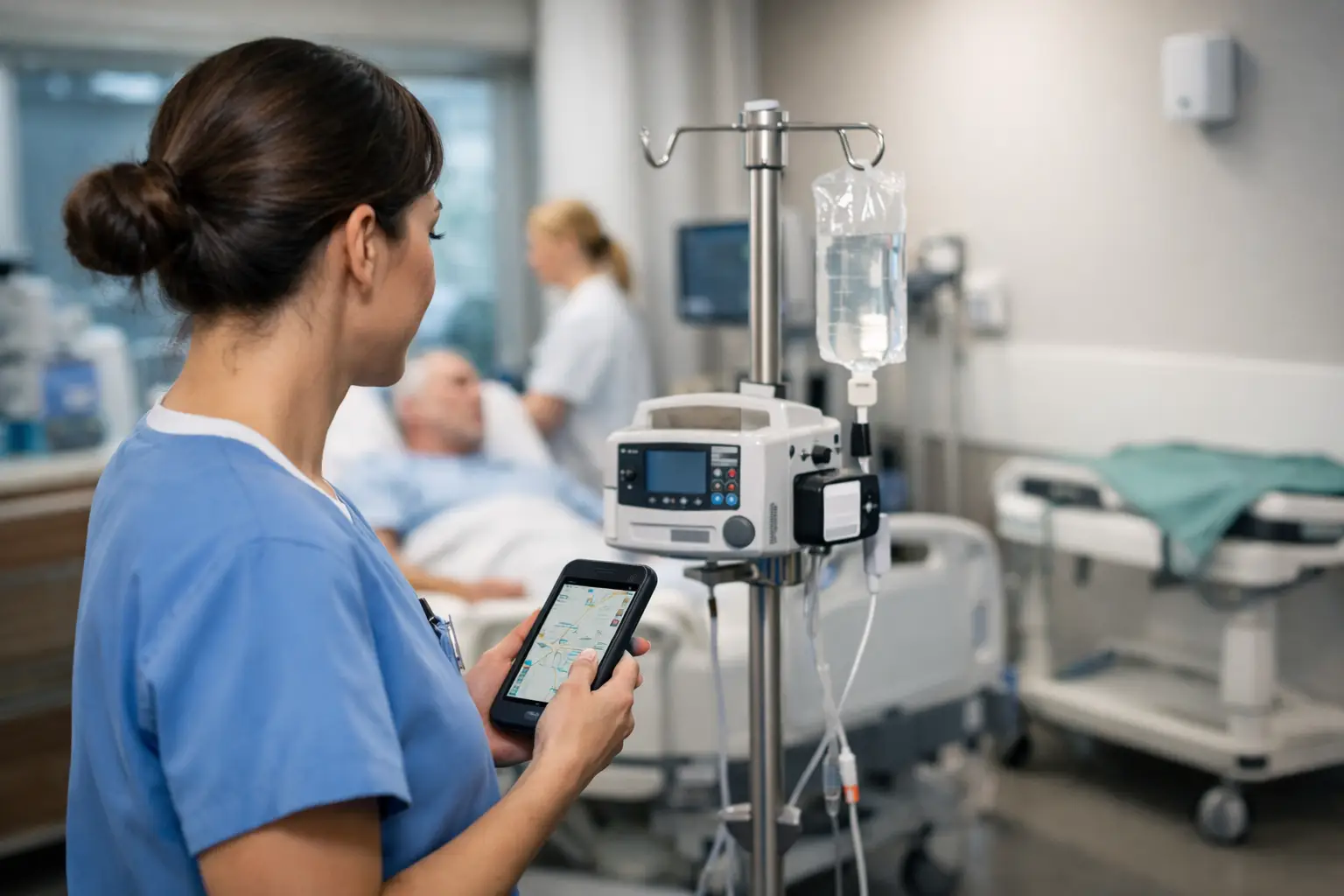
A clinician needs an infusion pump, a wheelchair or a portable monitor now, not after a call to three wards and a search of an equipment store. That is the operational problem behind how to locate hospital equipment: turning an uncertain search into verified, current location data without adding work for busy clinical and estates teams.
Hospitals are difficult environments for asset visibility. Equipment moves between wards, theatres, diagnostics, treatment rooms, stores and cleaning areas. It may be held for a patient, awaiting maintenance, charging, being decontaminated or simply left in an unexpected place. A spreadsheet, barcode scan or periodic stock check can establish ownership, but it cannot reliably answer where an item is at this moment.
A real-time location system, or RTLS, is designed to answer that question. The right approach depends on the equipment, the required accuracy and the decision staff need to make from the data.
Start with the equipment search that causes the most delay
Do not begin by tagging every movable item in the estate. Start with a defined operational issue: locating available infusion pumps on a ward cluster, finding pressure-relieving mattresses across a site, or identifying whether mobile diagnostic equipment has returned to the correct department.
Map the current process in practical terms. Who searches, where do they search, how is availability determined, and what happens if the item cannot be found? Include the status that matters. Location alone is useful, but a pump in a dirty utility room is not the same as a pump that is clean, charged, safety-checked and ready for use.
This exercise helps separate two related requirements. Asset management records what an organisation owns, its service history and planned maintenance. Equipment location identifies where it is or where it was last seen. Many hospitals need both, but they are not interchangeable.
Define location, availability and ownership separately
An effective design distinguishes the item’s position from its operational state. A tagged bed might be in a bay, but allocated to a patient. A tagged device could be in an engineering workshop, so it should not appear in a clinical availability search.
Set clear status rules before deployment. Some can come from existing maintenance or inventory systems. Others can be derived from location, such as a device entering a defined cleaning zone. The objective is not to create a more detailed map for its own sake. It is to show staff equipment that is appropriate for the task at hand.
Choose the right technology for the hospital environment
RTLS is an umbrella term for technologies that calculate or infer the location of a tagged asset. In practice, hospitals often require more than one location method because indoor and outdoor conditions differ.
Bluetooth Low Energy, or BLE, uses low-power tags and nearby gateways or beacons to identify an item’s presence in a room, zone or broader area. It is well suited where zone-level visibility is enough, such as confirming that equipment is on a ward, in stores or in a service area. BLE can support a wide deployment, but expected accuracy depends on site layout, tag configuration and gateway placement.
Ultra-wideband, or UWB, is an indoor positioning technology intended for higher-accuracy use cases. It measures signals between tags and fixed infrastructure to calculate a more precise position. Where supported by the deployment, UWB positioning can achieve accuracy of up to 10 cm. This is relevant when the difference between a room, a bay, an equipment rack or a handover point changes the operational outcome.
GPS is valuable when assets travel outside buildings, across large campuses or between sites. It is generally not a substitute for indoor positioning because satellite signals are limited within hospitals. Connected gateways provide the bridge between tags, badges, sensors and the location platform, carrying data from the physical environment into operational systems.
Match accuracy to the decision
Higher accuracy normally requires more infrastructure design, surveying and investment. It should therefore be justified by the workflow. If a porter needs to know which department holds a spare commode, zone-level information may be sufficient. If staff need to identify the exact position of specialist equipment in a large clinical area, higher-accuracy UWB may be the appropriate choice.
Consider building materials, multi-storey layouts, lift cores, plant rooms and areas with restricted access. A site survey should test real routes and real storage behaviours, not just open-plan corridors. The best system is one that remains useful when equipment is behind doors, moved between floors or temporarily stored outside its usual home.
Design tags and zones around real workflows
The tag is only one part of the system. It must be suited to the asset, attached securely and managed as part of normal equipment processes. A tag on a mobile device needs a practical replacement and battery approach. For equipment that is washed or frequently handled, the attachment method and tag specification need particular scrutiny.
Build a useful digital representation of the site. This includes wards, clinical rooms, equipment libraries, theatres, loading areas, stores, charging points, cleaning zones and biomedical engineering areas. These defined spaces are often called geofences: virtual boundaries that identify when an asset enters, leaves or remains in an area.
Geofences make location data actionable. For example, a system can flag equipment that has remained outside its assigned department for longer than expected, identify devices entering a maintenance zone, or show assets that have not returned after a procedure. The rules must reflect local operating practice. An automatic alert that ignores legitimate clinical variation will be ignored quickly.
Connect location data to action, not another dashboard
A map is valuable for a live search, but the greater operational benefit comes from connecting location to work. When an item is requested, teams should be able to identify the nearest suitable asset and allocate collection or delivery. When equipment enters an engineering zone, a workflow can record its arrival and prompt the next stage. When an asset leaves an agreed site boundary, the appropriate team can be notified for review.
This is where location-aware automation matters. Rather than relying on staff to remember a form or manually update a record, the system can use time and position as supporting evidence of a physical event. It can provide an audit trail for equipment movement, cleaning routes, handovers or attendance at a designated location.
The data should also support historical analysis. Repeated searches in the same departments may indicate insufficient equipment distribution. Assets routinely found in the wrong area may point to unclear return processes. Apparent shortages can sometimes be a visibility problem rather than a procurement problem, though this should be tested against utilisation and clinical demand rather than assumed.
Sense Presence combines proprietary tags, badges, gateways and software to create this type of real-world location data across indoor and outdoor workplaces. For hospital equipment, the relevant question is whether the chosen hardware and workflow design provide the accuracy, resilience and operational evidence required on that site.
Plan deployment with clinical, estates and IT teams
Equipment tracking touches clinical operations, infection prevention, estates, biomedical engineering, security, IT and procurement. Involve these teams early. Clinical users can define what “available” means. Engineering teams can align location data with maintenance processes. IT teams can assess network, security, data retention and integration requirements.
Run a focused pilot against a measurable use case. Test tag attachment, battery management, gateway coverage, map accuracy and the staff experience of finding an item. Include exceptions: equipment in a lift, a closed store, a cleaning area or a neighbouring department. A pilot should reveal where workflow rules need refinement before the system is scaled.
Governance matters even when the initial scope is equipment. If the platform may later locate staff through badges or wearable devices, be transparent about purpose, access controls and retention. Use proportionate policies, consult relevant stakeholders and assess data protection requirements. Location data should support safer, more efficient work, not create unnecessary monitoring.
Measure whether equipment is easier to find
Set a baseline before rollout. Useful measures include the time taken to locate priority equipment, the number of search calls to equipment libraries, equipment utilisation by area, time spent outside designated zones and the proportion of requests fulfilled without escalation.
Avoid treating a higher movement count as success. Constant movement can indicate poor availability planning, unnecessary transfers or unclear ownership. Review findings with the teams using the equipment and adjust zone definitions, search views and alerts accordingly. Location technology works best when it improves a process that people recognise as worth improving.
FAQs
What is the best way to locate hospital equipment?
It depends on the required accuracy. BLE-based RTLS may be suitable for ward or department-level visibility. UWB is more appropriate where teams need highly precise indoor positions. A hospital may use both, alongside GPS for assets moving between buildings or sites.
Can RTLS show whether equipment is ready for use?
RTLS can show location and movement, but readiness usually requires additional status information. This may come from maintenance records, cleaning workflows, charging checks or defined location rules. Design the search view so staff can distinguish an asset’s location from its clinical availability.
Does every piece of hospital equipment need a tag?
No. Begin with high-demand, mobile or difficult-to-find equipment where search time creates a meaningful operational impact. The value case for a low-cost, rarely moved item may be different from that for a shared mobile device used across multiple wards.
How accurate is hospital equipment tracking?
Accuracy varies by technology, infrastructure design and environment. Zone-level tracking may be sufficient for many use cases. In supported UWB deployments, positioning can be accurate to up to 10 cm. Site testing is essential because hospital layouts and workflows affect performance.
The practical test is simple: when staff search for a priority item, the system should help them make the next correct decision quickly. Build the deployment around that moment, then extend it where the evidence shows it can improve service delivery.