

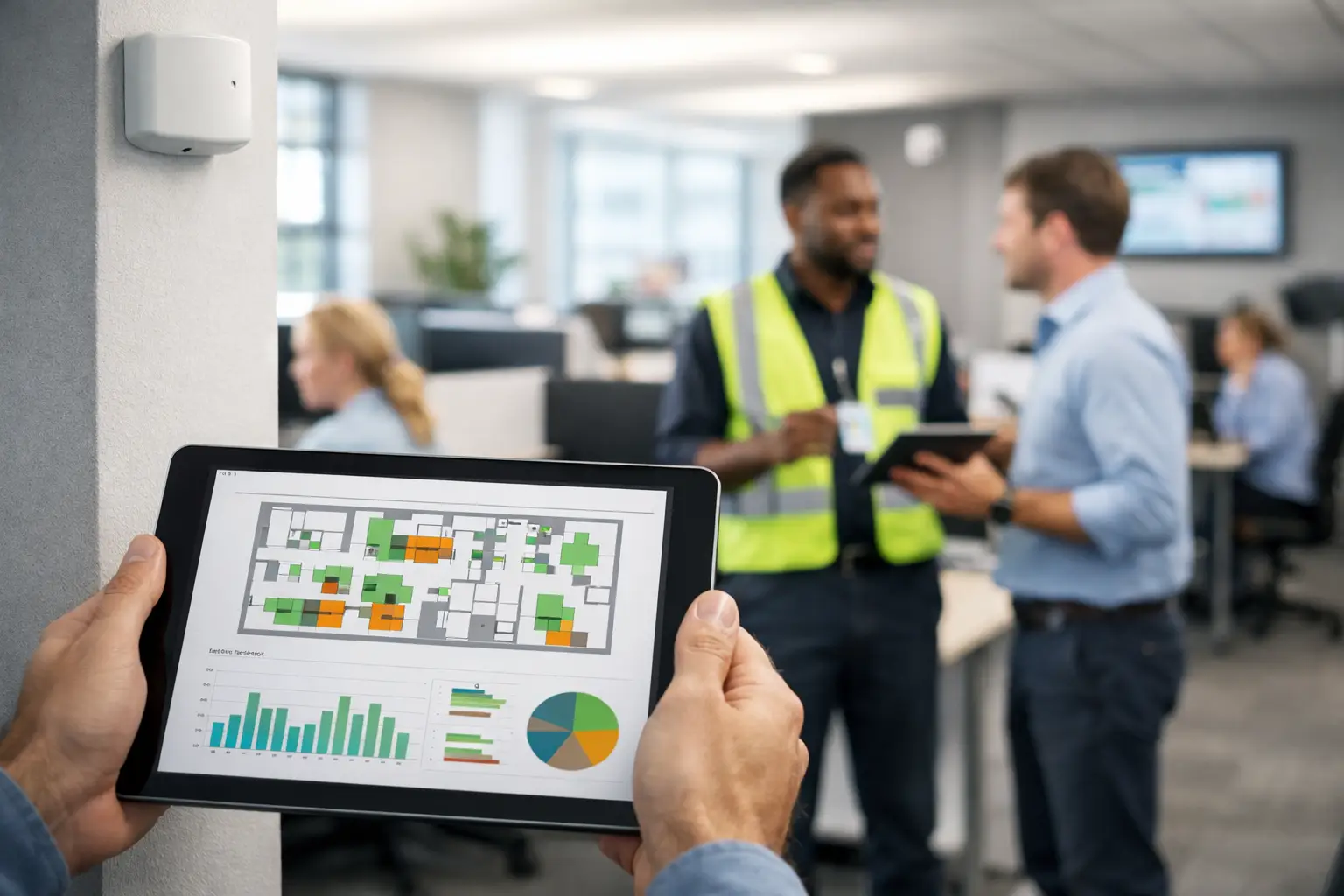
A meeting room booked for eight but used by two people, a production area that appears crowded on a floor plan but sits idle for hours, and equipment that cannot be found when a team needs it are all costly forms of poor visibility. Workplace space utilisation analytics replaces assumption with evidence, helping operational leaders understand how space, people and assets are actually used.
For complex workplaces, this is not simply a question of reducing desks or changing a booking policy. It is about making capacity available when it is needed, protecting people in busy or isolated areas, and designing workplaces around real operational patterns rather than occasional observations.
What is workplace space utilisation analytics?
Workplace space utilisation analytics is the process of collecting and analysing data about how physical areas are occupied and used over time. It can cover desks, meeting rooms, wards, workshops, loading bays, staff facilities, stores and external areas across a multi-site estate.
The useful distinction is between booking data and presence data. A booking system records intent: somebody reserved a desk or room. Presence data shows whether a person or tagged asset was actually there, for how long and, depending on the technology and policy in use, whether the space was used as intended.
This matters in environments where work does not happen at a desk. In healthcare, facilities management, manufacturing, construction and hospitality, activity moves between zones, buildings and sites. A meaningful view of utilisation may need to combine room occupancy, staff presence, asset availability, task demand and environmental conditions.
Why occupancy counts alone are not enough
A single occupancy figure can be misleading. A room that is occupied for ten minutes before a shift briefing has different operational value from a room used continuously for confidential meetings. A workshop may be lightly occupied but constrained by the location of critical tools, safety requirements or the flow of materials.
The questions behind the data should therefore be specific. Which spaces are consistently underused? Where do queues or congestion occur? Are teams travelling further than necessary to collect equipment? Do peak periods align with attendance patterns? Which areas need more capacity, and which need a different layout or operating model?
Historical trends provide the context for estate and capacity decisions. Real-time information supports the immediate operational response, such as directing a worker to an available area or locating an asset required for an urgent task. Both are valuable, but they should not be confused.
From occupancy to operational context
A practical analytics programme connects presence to the reason for being present. For example, a facilities team may want to know whether a cleaner arrived at the correct location, completed the task and had access to the equipment required. A simple people count will not answer that.
Location-aware workflows can add this context. A worker badge, asset tag or button can record a location event; a gateway receives the signal; software applies defined rules; and a workflow can record proof of attendance, prompt a task or escalate an exception. The result is a clearer audit trail than self-reported updates alone.
Choosing the right location technology
The right technology depends on the decision being made, the physical environment and the required level of accuracy. There is no universal answer, and specifying more precision than the use case requires can add unnecessary deployment cost and complexity.
GPS is well suited to outdoor positioning and movement between sites, but it is generally not appropriate for detailed indoor room-level decisions. Bluetooth Low Energy, or BLE, uses low-power signals from badges, tags or beacons and can support indoor presence and zone-based visibility. It is often appropriate when the key question is whether a person or asset is in a defined area.
Ultra-wideband, known as UWB, is designed for higher-precision indoor positioning in supported deployments. It can be used where the difference between adjacent bays, rooms or work zones has operational significance. Sense uses UWB positioning capable of up to 10cm accuracy in supported deployments, alongside BLE, GPS and connected gateways.
A real-time location system, or RTLS, brings these technologies together. It comprises physical devices, such as badges, tags, beacons and gateways, plus software that turns signals into usable location data. Geofencing then defines virtual boundaries around an area, allowing the system to recognise entry, exit or time spent within a zone.
Hardware matters to data quality
Workplace analytics is only as credible as the data beneath it. Software cannot infer reliable physical-world events if devices are poorly located, signals are inconsistent or the system does not reflect how people actually work.
This is why proprietary hardware and firmware deserve close scrutiny during evaluation. Badges can support worker presence and safety workflows. Tags can make mobile equipment visible. Gateways receive and relay location signals. Environmental sensors can provide additional context, such as conditions in a room or storage area. Buttons can enable an immediate alert when a worker needs assistance.
A well-designed deployment also considers battery management, device placement, radio conditions, site layout, network requirements and the practical reality of uniforms, personal protective equipment and shift handovers. A warehouse, hospital and construction site present very different challenges.
How to use the data without creating noise
The strongest workplace space utilisation analytics programmes begin with a decision, not a dashboard. If the aim is to reduce meeting-room no-shows, focus on booked versus actual occupancy and the duration of use. If the aim is to improve factory flow, examine dwell time, movement between work zones and the availability of shared assets.
Start with a defined operational hypothesis. A facilities leader might suspect that teams are unable to find collaboration space at shift-change times. Data can test whether demand is concentrated in particular locations, whether rooms are occupied by fewer people than planned, and whether another area could relieve pressure.
It is equally useful to identify exceptions. Repeatedly overcrowded zones may indicate a capacity or safety issue. Areas that are busy only at certain times may need a different cleaning, security or support schedule. Assets that spend long periods in unproductive locations may need a revised storage point, maintenance process or allocation rule.
Avoid treating every movement as a performance measure. The purpose is to improve workplace design and operational coordination, not to generate a stream of disconnected observations. Useful reporting should distinguish between normal variation, recurring constraints and events that require action.
Privacy and governance must be part of the design
Location data can be sensitive, particularly where it relates to employees. The best approach is transparent and proportionate: define the operational purpose, collect only the data required, set clear retention periods and explain who can access information and why.
Organisations should involve privacy, HR, employee representatives, health and safety and IT teams early. They should assess their obligations under UK data protection law and follow relevant ICO guidance. A data protection impact assessment may be appropriate where planned processing is likely to create higher privacy risk.
Good governance also improves adoption. Workers are more likely to trust a system when they understand that its purpose is to improve safety, locate essential equipment, verify service delivery or coordinate work, rather than monitor every moment without context.
Turning insight into action
The most valuable outcome is not a monthly utilisation chart. It is a better decision made while there is still time to act. That might mean dispatching the nearest qualified worker, making an unused room available, moving equipment closer to demand or checking on a lone worker who has triggered an SOS alert.
Sense Presence is designed around this connection between accurate location and operational action. Its badges, tags, gateways, sensors and software can create real-world location data, while SenseAutomate can support no-code, location-aware workflows. For a space programme, that means presence can inform both longer-term planning and immediate coordination.
The appropriate starting point is usually a contained area with a clear problem: an underperforming meeting suite, a difficult-to-manage equipment store, a congested service corridor or a site where teams lose time locating resources. Prove what data is needed to answer that question, then expand with a model that respects the operational and privacy requirements of each location.
FAQs
What is the difference between space utilisation and occupancy?
Occupancy describes whether a space contains people or assets at a point in time. Space utilisation looks at how often, how long and how effectively that space is used over a period. It can include capacity, purpose, patterns of demand and operational constraints.
Do workplace analytics require UWB?
No. BLE may be sufficient for area or zone-level visibility, while GPS can support outdoor use cases. UWB is most relevant when precise indoor position materially changes the decision, such as distinguishing between close workstations, bays or defined safety zones.
Can space data support worker safety?
Yes, when configured for that purpose. The same location infrastructure can help identify a worker’s last known or current location, support lone-worker check-ins, provide SOS alerts and help responders reach the relevant area faster. Safety processes should be designed and tested with the site team.
How should an organisation begin?
Begin with one operational question that people can act on. Establish the required accuracy, areas to be covered, devices involved, governance controls and success measures before collecting data. A focused deployment creates a more useful foundation than measuring every square metre simply because it is possible.