

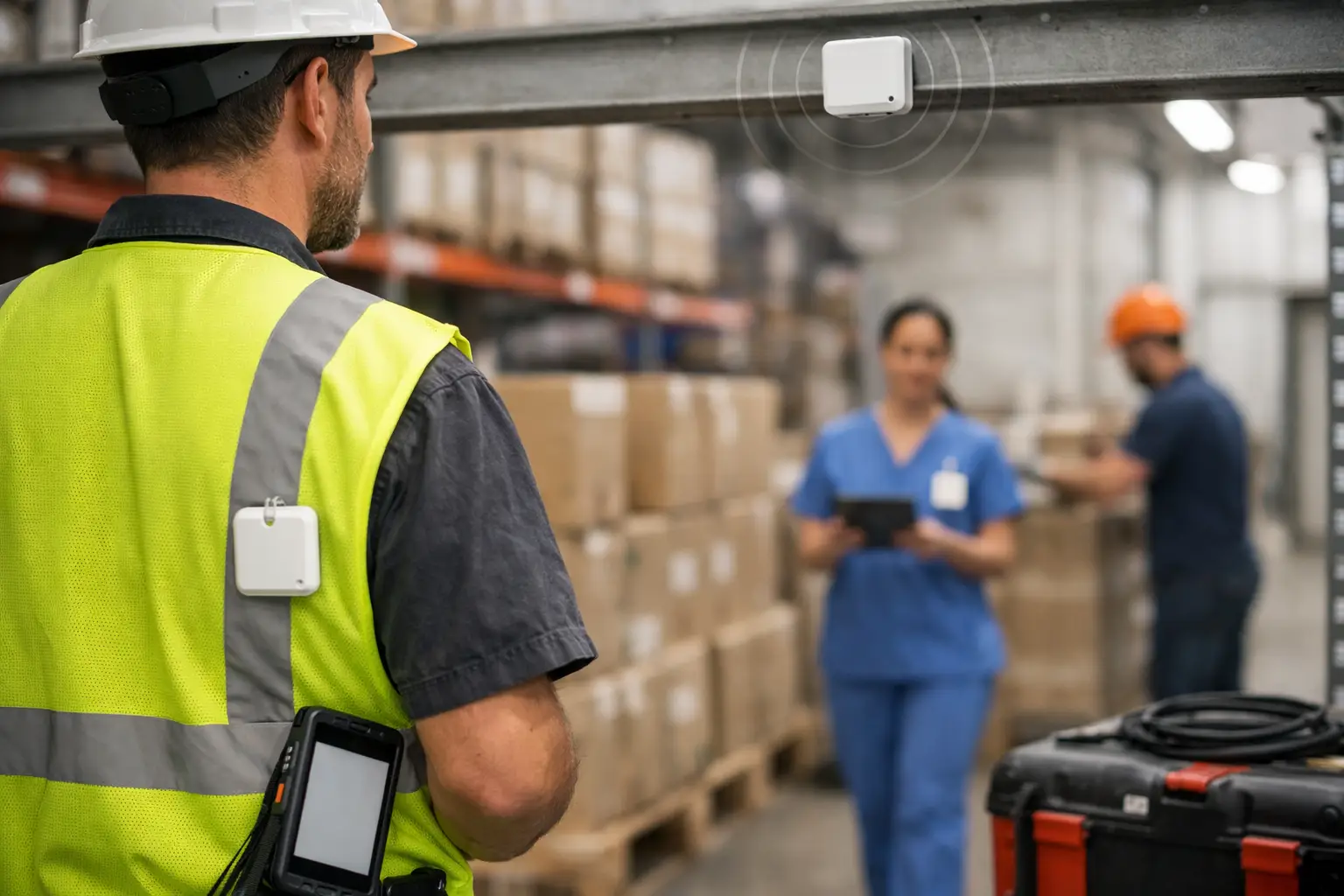
When a worker raises an alarm, an asset disappears from a production area, or a team needs to prove a visit happened at the right location, an approximate answer is rarely enough. Operations teams need to know who or what is where, with sufficient confidence to act. That is where UWB technology has practical value: it provides highly precise indoor position data in environments where GPS cannot reliably do the job.
What is UWB technology?
Ultra-wideband, usually shortened to UWB, is a short-range wireless technology that can measure the position of a compatible badge or tag with high precision. In a workplace real-time location system, or RTLS, fixed infrastructure measures signals from mobile devices worn by people or attached to assets. Software then turns those measurements into a location on a site map, a zone event, or an operational workflow.
Unlike technologies designed principally for sending large amounts of data, UWB is well suited to measuring distance. It uses very short radio pulses across a wide range of frequencies. By calculating how long a signal takes to travel between a device and fixed reference points, the system can establish a device’s position.
The result is not simply a dot on a map. It is a physical-world data source that can support safety response, asset finding, attendance verification, task allocation and evidence that work was completed at a defined place and time.
Why indoor precision changes operational decisions
Many workplace location problems are not solved by knowing that someone is somewhere in a building. A security team responding to an SOS alert may need to identify the correct floor, ward, production line or service corridor. A facilities manager may need to dispatch the nearest available engineer, rather than radio several people across a site. A manufacturing team may need to locate a specific tool without interrupting a shift to search for it.
This is the difference between presence data and actionable location data. If the position is too broad, teams still rely on calls, manual checks and assumptions. If it is sufficiently accurate for the task, location can become an event that triggers a defined response.
In supported deployments, UWB positioning can achieve accuracy of up to 10 cm. That level of accuracy is useful where adjacent rooms, bays, workstations or access points need to be distinguished. It does not mean every environment will produce the same result. Layout, infrastructure placement, building materials, obstructions, tag orientation and the way people move through the space all affect design and performance.
For outdoor estates, GPS may remain the appropriate location source. The operational requirement should determine the technology, rather than assuming a single positioning method will cover every part of a multi-site operation.
How UWB RTLS works
A UWB RTLS has three practical elements: a mobile device, fixed site infrastructure and software that interprets the location data. The mobile device might be a worker badge or an asset tag. Fixed gateways or reference points are installed around the area to be covered. Their measurements are combined to calculate the device position.
From radio measurement to a workplace event
The system continually receives position information as people and assets move through the covered area. Software can show a live location, retain historical movement records where configured, and detect when a device enters or leaves a defined zone.
A zone can represent a physical place with operational meaning: a loading area, a restricted room, a patient bay, a customer location, a plant area or a designated muster point. When a tagged item or badge crosses that boundary, the platform can record an event or trigger an agreed workflow.
For example, a lone worker could use a wearable button to raise an SOS alert. Location information can help responders identify where to go, while escalation procedures determine who receives the alert and what happens next. Similarly, a team can verify arrival at a work area or record a task completion event using the combination of location and time data. The technology supports the process, but the organisation must still define suitable response procedures, staffing and accountability.
Why hardware and firmware matter
Location quality is not only a software question. The badge or tag, the fixed infrastructure, the device firmware and the physical installation all influence whether the data is dependable enough for a specific workflow.
A workplace deployment should therefore be designed around real movement patterns and operational decisions. Which entrances are used? Where do workers spend time? Are there metal structures, machinery, shelves or external areas? Does the organisation need live response, historical analysis, or both? These questions shape the placement of infrastructure and the device type needed.
This is also why purpose-built workplace hardware has value. Badges, tags, gateways, beacons, buttons and environmental sensors can provide different signals from the physical environment. Joined to one platform, they create a clearer picture than forms, phone check-ins or self-reported updates alone.
UWB, BLE and GPS: choosing the right technology
UWB is not a replacement for every location technology. It is one part of a practical location strategy.
GPS is effective outdoors, where devices can receive satellite signals. It is commonly used for vehicle, field-worker and estate-level positioning, but its performance indoors is limited. BLE, or Bluetooth Low Energy, can provide lower-cost proximity and zone awareness. It is often appropriate when an organisation needs to know that a person or asset is near a beacon, in a room or within a broad area rather than at a highly precise coordinate.
UWB is the stronger choice when the use case requires accurate indoor positioning, such as locating equipment among closely spaced bays, distinguishing between nearby work areas or directing emergency response to a specific internal location. It generally requires dedicated infrastructure, so the case for UWB should be based on the cost and risk of imprecise information.
Many complex workplaces use a combination. GPS can support outdoor movement, BLE can cover proximity use cases, and UWB can be deployed in the indoor areas where precision materially improves an outcome. Connected gateways provide the route from devices in the field to the central platform.
Turning location data into operational action
A map alone does not improve a process. The value comes when location data is connected to the decisions teams already make.
Consider a facilities operation across a hospital, campus or social housing estate. A service request arrives for a priority issue. Rather than assigning work solely by rota or phone availability, a workflow can identify an appropriate nearby operative, issue the task and record presence at the required location. When the job is completed, the organisation has a stronger audit trail than a manual status update alone.
In manufacturing, asset tags can reduce the time spent looking for shared equipment. In hospitality and retail, managers can better understand staff coverage across large premises. In construction, designated zones can help verify that workers have reached a required area before a task begins. Each application depends on site design, policy and the quality of the underlying process, not location technology in isolation.
Sense Presence is designed around this connection between physical devices and operational software. Its proprietary hardware and firmware combine UWB, BLE, GPS and connected gateways, while location events can feed no-code workflows through SenseAutomate. That may include task allocation by proximity, proof of completion, lone-worker check-ins, environmental triggers or alerts that require a defined response.
Deployment, privacy and procurement questions
Before selecting UWB, set out the decision the data must support. “Track staff” is neither a clear operational requirement nor a useful technical specification. “Identify the location of an SOS alert in a high-risk indoor area” or “find critical equipment across a production floor” gives the project a measurable purpose.
A credible assessment should examine coverage areas, required accuracy, device form factor, battery and charging approach, network connectivity, map availability, integration requirements and what happens when a device is not detected. It should also distinguish between a proof-of-concept area and the conditions of a full deployment across multiple buildings or sites.
Location data involving workers needs proportionate governance. Employers should be transparent about why data is collected, how it will be used, who can access it and how long it is retained. Privacy, employment and health and safety teams should be involved early, particularly where data may be used for attendance, performance-related processes or safety escalation. UK data protection obligations depend on the circumstances, so organisations should seek appropriate advice rather than treating technology settings as a complete compliance answer.
FAQ
How accurate is UWB technology indoors?
Accuracy depends on the deployment and environment. In supported deployments, UWB can provide positioning accuracy of up to 10 cm. Site surveys, infrastructure placement, obstructions and device use should be assessed against the required operational outcome.
Can UWB technology track people and assets?
Yes. UWB badges can be used for workers and UWB tags for equipment or other assets, provided the relevant infrastructure is installed. The use case should determine the device, coverage and privacy controls.
Is UWB better than Bluetooth for workplace tracking?
It depends on the required precision. BLE can be suitable for proximity and broad zone awareness. UWB is better suited to use cases requiring more precise indoor location, particularly where nearby rooms, bays or work areas must be distinguished.
What should an organisation do first?
Start with the moment where delayed, inaccurate or unverified location creates operational risk: an emergency response, missing asset, task dispatch or proof-of-service gap. A well-defined problem makes it easier to choose the right mix of UWB, BLE, GPS, devices and workflows.