

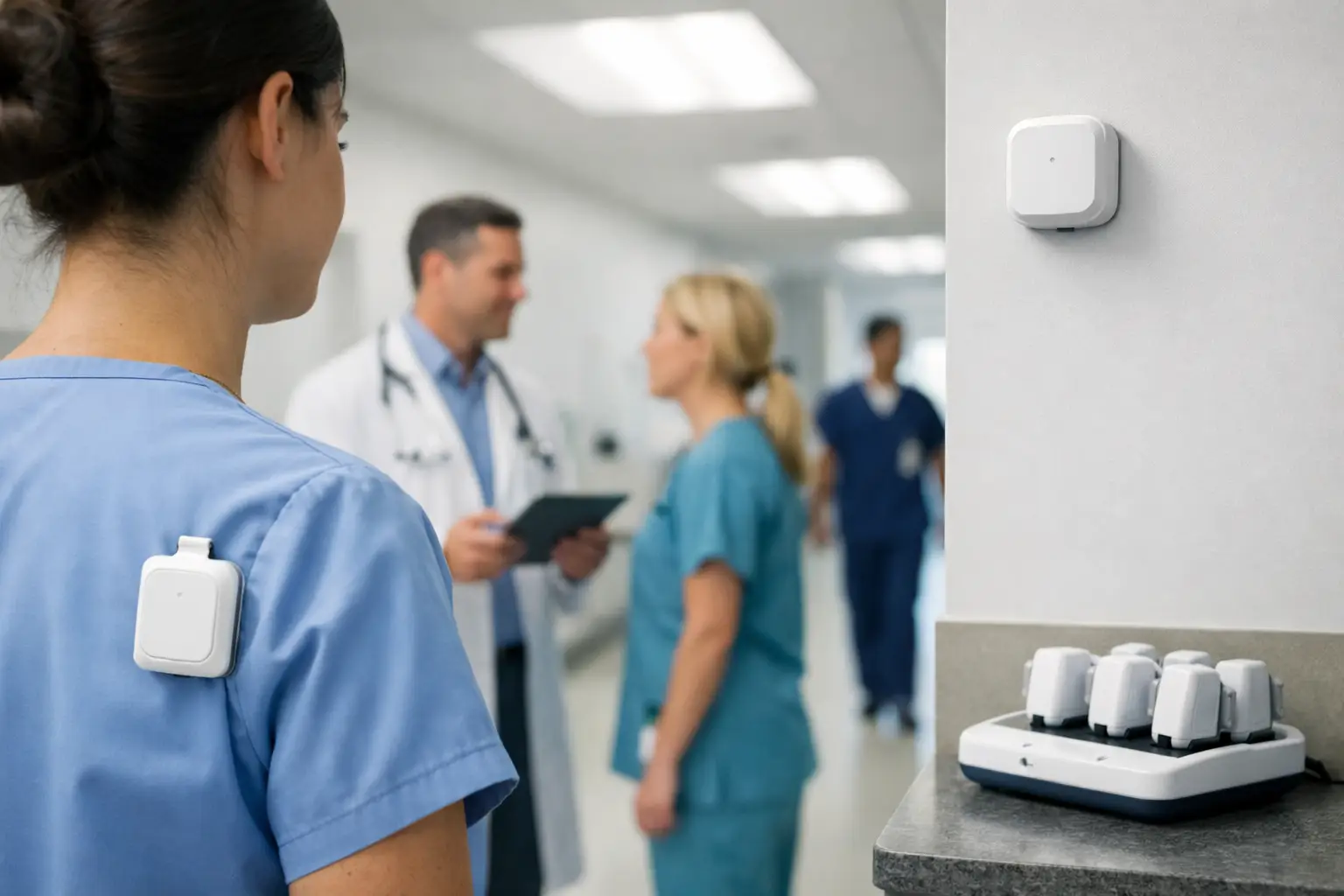
A healthcare staff location system is most valuable when a ward, hospital campus or community care operation cannot answer a basic operational question quickly: where is the right person, and are they safe? Delayed responses to personal alarms, time spent searching for colleagues or equipment, and incomplete records of visits all create pressure on already stretched teams. Real-time location technology gives operational leaders an evidence-based view of presence and movement, without making staff chase paperwork or rely on memory.
What is a healthcare staff location system?
A healthcare staff location system is a real-time location system, often called RTLS, that identifies the position of staff within a defined environment. Depending on the technology and the deployment, it can show whether a worker is in a building, on a floor, in a zone or at a precise point within a room.
The system normally combines wearable badges or tags with fixed infrastructure and software. A badge carried by a nurse, porter, security officer or estates operative communicates with gateways, beacons or receivers installed around the site. The platform turns those signals into usable location data, showing current presence, historical movement and operational events.
This is different from a workforce app that records a manual check-in. A check-in states that somebody reported being somewhere. An RTLS deployment can create physical-world evidence that a badge was detected in the relevant area at a particular time. That distinction matters where response, safety, attendance and proof of activity need to stand up to operational scrutiny.
Why location visibility matters in healthcare
Healthcare estates are rarely simple. They may include wards, theatres, outpatient departments, plant rooms, car parks, community clinics and satellite sites. Staff work across shifts, move between controlled and public areas, and may be required to respond to incidents without delay.
The immediate use case is often staff safety. If a worker triggers an SOS alert, a location-aware system can help a response team identify where help is required rather than searching across a large site. For lone workers, scheduled check-ins, wearable buttons and, where appropriate, fall-detection events can add another layer of support. The value is not merely an alarm. It is the ability to connect the alarm to a usable location and an agreed response workflow.
There are operational benefits too. A coordinator can direct the nearest appropriate porter to a transfer request, locate an available security colleague during an incident, or understand whether a task was attended at the correct location. In facilities and estates teams, time-and-location records can provide proof that a planned inspection, cleaning task or maintenance visit took place in the designated zone.
Location data should not be treated as a substitute for professional judgement, staffing levels or incident procedures. It is supporting evidence that helps teams make better decisions under pressure.
The technologies behind staff location
No single technology suits every healthcare environment. The right design depends on the area to be covered, the level of precision required, the movement of people between indoor and outdoor spaces, and the event that the organisation needs to support.
UWB for precise indoor positioning
Ultra-wideband, or UWB, is designed for high-precision indoor positioning. It measures the time taken for radio signals to travel between a badge and fixed anchors or gateways. In a properly designed deployment, UWB can identify location to a much finer level than broad zone-based systems. Sense states that its UWB positioning can provide accuracy of up to 10 cm in supported deployments.
That level of precision can be relevant where the difference between a bay, room, doorway or specific protected area changes the required response. It also requires planning. Building layout, infrastructure placement, radio conditions and the coverage objective all affect practical performance. UWB may be unnecessary for an application that only needs to confirm that someone entered a ward or reached a particular department.
BLE for zones, presence and efficient coverage
Bluetooth Low Energy, or BLE, is commonly used for location and proximity applications. BLE badges, tags and beacons can support room or zone-level presence, depending on the design and density of the installed infrastructure. It is useful where organisations need a practical balance of coverage, battery life and deployment cost.
A BLE deployment can support workflows such as confirming arrival in a clinic, identifying time spent in a service zone, or triggering an alert when a worker enters or leaves a defined area. The precision is not automatically equivalent to UWB, so the use case should set the expectation. If the operational question is “has this person reached the isolation ward?”, BLE may be suitable. If it is “which side of this room are they on?”, a more precise method may be needed.
GPS for campuses and mobile teams
GPS is suited to outdoor environments, such as hospital grounds, vehicle areas and community care routes. It is not generally the answer for reliable indoor location because satellite signals are weakened or obstructed by buildings.
For organisations with mixed estates, a combination of GPS outdoors and UWB or BLE indoors can provide continuity. This matters for teams travelling between buildings, attending remote sites or working across a large campus. Geofencing can then define virtual boundaries around relevant locations, such as a clinic, depot or customer site, and create an event when a worker enters or leaves.
Gateways, sensors and wearable devices
The visible badge is only one part of the system. Gateways receive and pass location data into the platform. Beacons and fixed reference points support indoor positioning. Buttons can initiate SOS alerts, while environmental sensors can add context such as temperature, air quality or other site conditions.
The quality of the data depends on how these components work together. Proprietary hardware and firmware can matter because the badge, gateway, tag and software are designed as a connected system rather than assembled from unrelated devices. Sense Presence combines these elements to support indoor and outdoor location, worker safety and operational workflows from the same location foundation.
From a dot on a map to a healthcare workflow
A location display alone does not improve a response. The operational value comes when location data is connected to the event, responsibility and next action.
Consider a lone worker entering a plant room. A zone entry can start a check-in window. If the worker does not confirm they are safe, or if an SOS button is pressed, the system can notify the relevant response process with the latest known location. A security lead does not need to begin with a broad call-out to establish where the incident occurred.
For planned work, staff can be allocated tasks by proximity and availability, subject to role and local policy. When the task is completed, the system can record location and time as evidence of attendance at the correct place. That record is particularly useful for cleaning, inspections, portering and estates activity where a simple completed tick box does not show where the work happened.
No-code location-aware automation can connect these events to existing operational systems. A location event might create a task, update a status, prompt a check-in or escalate an exception. The aim is to reduce manual hand-offs, not to add another dashboard for teams to watch.
Deployment questions healthcare buyers should ask
The strongest projects begin with a clearly defined decision that location data will improve. “Track staff” is too broad. “Locate the nearest trained responder after a duress alert” is specific enough to shape the required accuracy, coverage and workflow.
Buyers should establish whether they need building-level, zone-level, room-level or precise positioning; which roles need badges; how visitors, agency workers and contractors will be handled; and how indoor and outdoor coverage should transition. They should also assess battery management, device durability, infrastructure installation, network requirements and the process for replacing or reassigning badges between shifts.
Integration should be considered early. A system may need to exchange events with task management, security, facilities, visitor, clinical or incident-management platforms. The practical question is not simply whether an integration exists. It is which data should move, who owns it, and what action follows when an event is received.
Privacy, trust and governance
Staff location data is personal data when it can be linked to an identifiable individual. A successful programme needs a defined purpose, proportionate configuration and clear communication with staff and representatives. The Information Commissioner’s Office provides UK guidance on data protection and employee monitoring, and organisations should seek their own data protection and employment advice for their circumstances.
Good governance separates safety and operational use from indiscriminate monitoring. Define when location is collected, which areas are covered, who can view live and historical data, how long records are retained, and how access is audited. Explain the safety scenario, the evidence being collected and the limits of the system before rollout.
This also improves data quality. Teams are more likely to wear and maintain badges properly when the purpose is credible: a faster response to a call for help, less time spent locating colleagues, or a simpler way to prove work was completed.
FAQ
Is a healthcare staff location system only for hospitals?
No. It can support hospitals, care homes, community healthcare providers, clinics, mental health facilities, ambulance support operations and healthcare estates teams. The design should reflect the environment and the operational need, from campus safety to proof of attendance at dispersed sites.
Can staff location work indoors and outdoors?
Yes, but different technologies are appropriate for different places. UWB and BLE are commonly used for indoor positioning, while GPS is suited to outdoor coverage. A combined approach can support staff moving between buildings and across wider estates.
How accurate does a staff location system need to be?
It depends on the decision being made. Zone-level visibility may be enough to confirm that a worker reached a ward. Precise indoor positioning may be required for rapid incident response within a large or complex department. Define the operational question before selecting the technology.
Can location data prove that work was completed?
It can provide supporting evidence that a badge or tag was present at a particular location and time. Combined with a task event or completion workflow, this creates a stronger audit trail than a manual confirmation alone. It should be designed around the actual work process and not treated as evidence of work quality by itself.
A well-scoped deployment starts with one moment where uncertainty creates risk or delay. Solve that moment with the right level of location accuracy, a clear response process and transparent governance, then build from evidence rather than assumptions.