

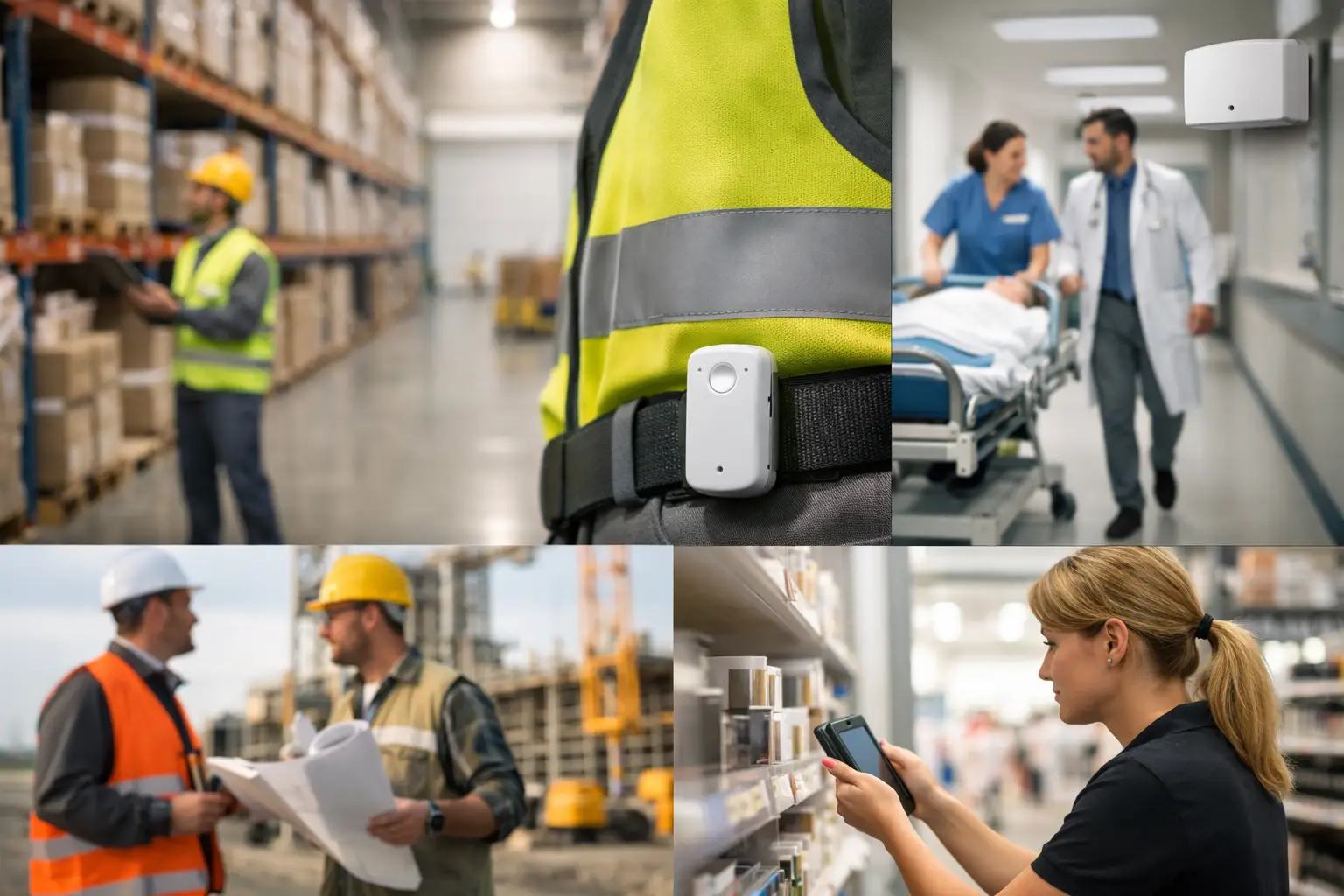
A missing wheelchair on a hospital ward, a lone engineer who has not checked in, or a facilities team dispatched from the wrong side of a site all expose the same operational gap: decisions are being made without reliable presence data. BLE location tracking gives organisations a practical way to understand where tagged assets and opted-in workers are within a defined environment, without relying on phone updates, paper records or memory.
For many workplaces, it is not about following every movement. It is about locating the right equipment, directing the nearest suitable person, verifying that a task happened at the required place, and providing faster assistance when something goes wrong.
What is BLE location tracking?
BLE stands for Bluetooth Low Energy. It is a low-power wireless technology used by tags, badges, beacons and sensors to transmit small signals at regular intervals. A BLE tag might be attached to a mobile asset, while a badge can be worn by a member of staff. Gateways or receivers placed around a building detect those signals and pass the resulting data to a software platform.
At its simplest, the system can show that a tag is near a particular gateway or within a zone. This is often enough for operational questions such as whether a cleaning trolley is on a floor, whether a contractor has arrived at a plant room, or whether equipment has left a controlled area.
BLE is also commonly used for proximity and zone-based events. A worker entering a designated area can trigger a clock-in record, a task prompt or a verification step. An asset crossing a boundary can create an alert. The useful output is not merely a dot on a map. It is a recorded physical event that can support action, reporting and audit trails.
Where BLE tracking works well – and where it does not
BLE has a strong role in workplace location systems because tags can be compact, cost-conscious and energy-efficient. It is particularly effective where the business needs room-level, area-level or proximity visibility across large indoor estates. This can include care settings, retail estates, factories, hotels, depots, construction compounds and customer sites.
Its limitations matter just as much. BLE signal strength can be affected by walls, metal, machinery, people, shelving and the layout of a building. A signal can indicate proximity without establishing an exact position. The result is that BLE is generally best suited to presence, zone detection and asset finding rather than centimetre-level positioning.
That distinction should shape the requirement. If the question is, “Is this item on site or in this department?”, BLE may be appropriate. If the question is, “Which side of this bay is the worker standing on?”, a higher-precision technology such as Ultra-Wideband, or UWB, may be the better choice. UWB uses short radio pulses and purpose-designed infrastructure to calculate position more precisely. In supported Sense deployments, UWB positioning can provide accuracy of up to 10 cm.
GPS serves a different purpose again. It is useful outdoors, where there is a clear view of satellites, but is usually unsuitable for dependable indoor positioning. Complex organisations often need a combination: GPS for travel and external sites, BLE for indoor zones and broad asset visibility, and UWB for critical indoor areas requiring high accuracy.
From signals to operational decisions
A useful real-time location system, or RTLS, combines hardware, connectivity and software. Tags or badges emit BLE signals. Connected gateways receive them. The platform interprets the data against a site map, defined zones and business rules. Buttons and environmental sensors can add context when location alone is not enough.
Consider a facilities management team covering a large hospital or university campus. BLE tags on equipment can reduce time spent searching for high-demand items. A task can be allocated to an available operative close to the reported issue, rather than simply to the next name on a list. When the operative reaches the correct plant room, their presence can form part of proof that the visit took place.
For worker safety, a wearable badge can provide more than an identifier. A worker may use an SOS button to request help, while their recent or current location gives responders a practical starting point. Lone-worker check-ins and fall-detection events can be connected to the same response process where the selected hardware and workflow support them. The operational value comes from joining the alert to an accurate site context, not from collecting location data for its own sake.
Location-aware automation also helps reduce the gap between a physical event and a digital record. A zone entry might initiate a checklist, while a verified presence and timestamp can support proof of completion. Environmental sensors can add another layer, for example by raising an alert when a monitored condition occurs in a defined area. The exact workflow should reflect the risk, service standard and site process rather than forcing teams into generic forms.
Designing a BLE location tracking deployment
The quality of a BLE deployment depends less on attaching tags everywhere and more on clear operational design. Start with the decisions that teams cannot make reliably today. It may be finding critical equipment, validating attendance at dispersed locations, protecting workers in isolated areas, or proving service delivery at a customer site.
Next, define the level of location certainty required. Zone-level visibility requires a different gateway layout from near-real-time room-level monitoring. Surveying the physical environment is essential: building materials, ceiling heights, access routes, power availability, radio interference and temporary site changes all affect placement. Warehouses, production areas and construction sites deserve particular care because layouts and obstructions can change.
The following questions should be resolved before procurement:
- Which assets, people or areas create the greatest operational risk or delay?
- Is the required outcome presence in a zone, proximity to an item, or precise indoor coordinates?
- How quickly must an alert or update be received and acted upon?
- Who owns tag issue, battery management, lost-device procedures and site changes?
- Which existing systems need location events, such as task management, security or workforce records?
A pilot should test real conditions rather than an ideal floor plan. Ask users to find an asset during a busy shift, respond to an SOS scenario and complete a location-verified task. Measure whether the information is understandable and whether supervisors have a defined response. Technology can make an event visible; operating procedures determine whether that visibility improves the outcome.
Privacy, workforce trust and governance
Location technology requires a clear purpose and proportionate design. For UK employers, location data relating to identifiable workers may be personal data. Organisations should involve data protection, HR, safety and employee representatives early, explain what is collected and why, and define retention, access controls and escalation processes. ICO guidance and UK GDPR obligations should inform the assessment, particularly where monitoring could be intrusive.
In practice, confidence improves when workers can see the safety or operational purpose. A system designed to support emergency assistance, site access verification or hazardous-area protection is different from unrestricted, continuous monitoring. Set boundaries in the technology as well as the policy: use relevant zones, appropriate access permissions and retention periods aligned to the stated purpose.
Choosing the right workplace location platform
Buyers should look beyond a dashboard demonstration. The most useful platforms are built around reliable physical-world data, with hardware and firmware designed to work together. Compatibility between badges, tags, gateways, buttons, sensors and software affects deployment effort, ongoing support and the quality of the events produced.
Sense Presence combines proprietary workplace hardware with BLE, UWB, GPS and connected gateways, allowing organisations to apply the appropriate technology to each environment. That matters where the same operation spans offices, service corridors, production lines, external yards and remote customer sites. It also creates a foundation for location-aware workflows, including task allocation by proximity, verified completion and safety assistance.
The right choice is rarely the technology with the longest feature list. It is the system that provides sufficient certainty for the operational decision, can be maintained across the estate, and turns location signals into accountable action.
FAQ
Is BLE accurate enough for employee location tracking?
It depends on the requirement. BLE can be highly useful for identifying presence within a zone, room or nearby area, and for triggering location-based processes. It is not normally the first choice when an organisation needs precise coordinates within a small space. For high-precision indoor use cases, assess UWB alongside BLE.
Does BLE tracking work without Wi-Fi?
BLE devices transmit their own Bluetooth signals, but the collected data still needs a route to the platform. Connected gateways commonly provide this connection using the site network, cellular connectivity or another configured backhaul method. The design should account for network coverage, resilience and the conditions at each site.
Can BLE tags track assets and workers at the same time?
Yes. A single RTLS can use different device types for different purposes, such as tags for equipment and badges for workers. The governance, data access and retention rules may differ because employee location data requires particular care.
What is the best first use case for BLE location tracking?
Choose a recurring operational problem with a clear response: locating frequently searched-for assets, confirming visits to defined zones, or improving assistance for workers in isolated areas. A focused first deployment gives teams a practical way to test the process, build trust and decide where broader location visibility will make the next difference.